Measuring a sofa bed mattress (thickness rules + common mistakes)
Better days start with a better sleep.
Perfect fit. Built-to-order. Suited for every sofa bed.
The foolproof guide to measuring a sofa bed mattress
Ordering the right sofa bed mattress replacement is easy — measuring it correctly before ordering is where most people go wrong. And boxing up a 50-pound mattress to return it is a nightmare.
This guide is built to prevent that. We’ll walk you through the exact measurement process, including:
- Where to place the measuring tape
- What to do when the old mattress is missing
- How to apply the “rounding” rules
- How to choose the right sleeper sofa mattress thickness so the mechanism closes correctly
Sleeper sofa size chart
Sofa beds come in tons of different sizes. The biggest difference between standard mattresses and sofa bed mattresses (also known as hide-a-bed, pull-out couch, and sleeper sofa mattresses) is length.
Sofa beds are typically 3 to 8 inches shorter.
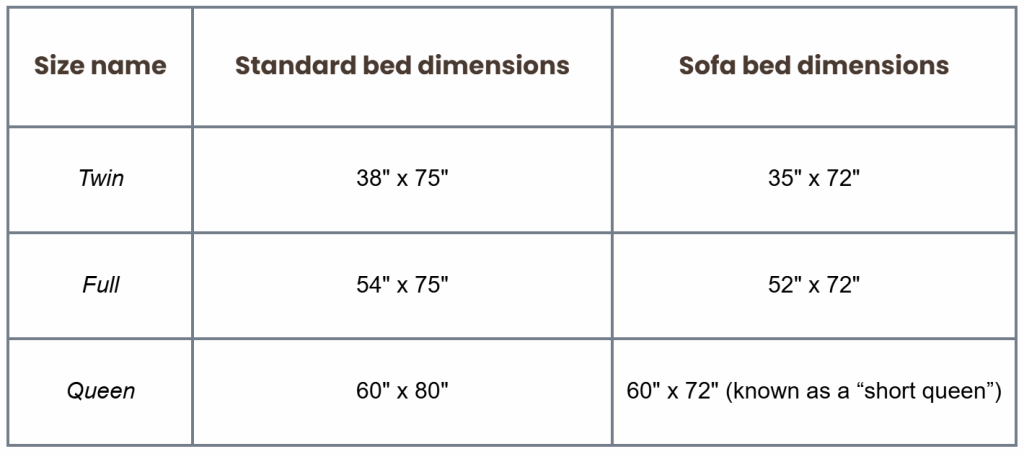
Important: These are typical hide-a-bed mattress sizes, not universal ones. Some brands use slightly different dimensions (for example, some “sofa queen” mattresses are closer to 60″ x 74″). Your measurement matters more than the label.
What You'll Find In This Article
The “short queen” explained
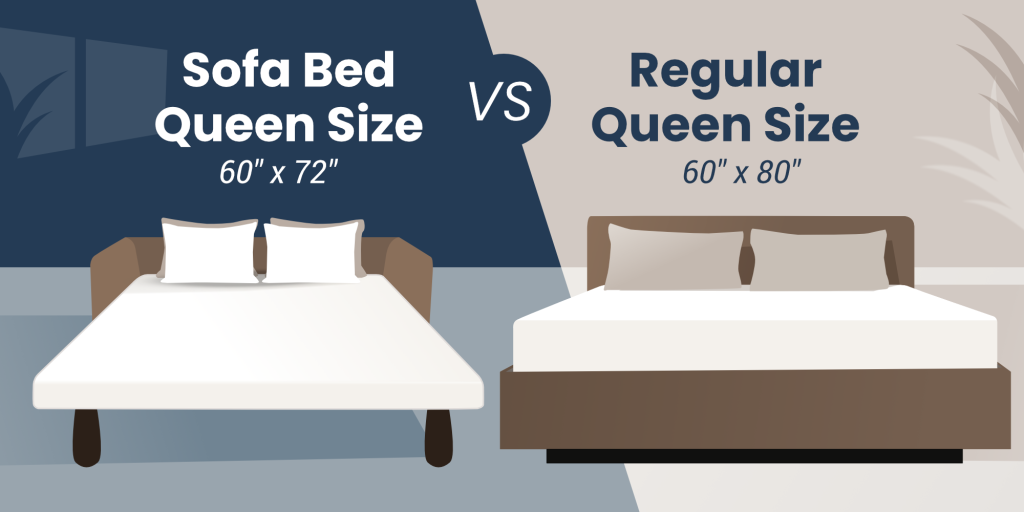
A “standard” everyday queen mattress is 60″ x 80″ — but a queen sofa bed mattress is almost never 60″ x 80″.
In sleeper sofas, “queen” usually means the width is queen-like (about 60″), but the length is shortened so the mattress can fold into the couch. A common sofa queen size is 60″ x 72″, and some brands run around 60″ x 74″.
Step 1: Pre-measurement checks
A lot of measuring mistakes happen before anyone even starts measuring. Spend two minutes on these checks first and the rest of the process gets much easier.
a) Is the old mattress missing or deformed?
Even if it is, you can still measure for the correct replacement Sofa Bed mattress size by measuring the usable space inside the frame (the cavity).
In fact, it’s actually the better method for measuring mattresses!
b) If the mattress is missing, identify your sleeper mechanism
If your mattress is missing, you won’t be able to choose the right mattress thickness until you know what kind of mechanism you have. This is because the support deck and fold pattern determine how much mattress the sofa can hold when closed.
A mattress that works in one sleeper can be too thick for another, even if the sofa bed mattress dimensions are the same. Most mechanisms fall into one of these broad categories:
- Classic pull-out
- Platform-style (including many premium designs)
- Trundle style
Step 2: Measure the mattress
There are two great ways to measure:
- Measure the existing mattress (best when it’s present and likely the original size)
- Measure inside the frame/cavity (best when the mattress is missing, deformed, or suspiciously wrong)
Mattress measuring steps
Step 1: Determine if you’re going to be measuring the mattress itself, or the inside of the frame/cavity. If the mattress is bulging or deformed, measure the frame.
IF MEASURING THE MATTRESS:
Step 2: Measure the length of the mattress (from the head of the bed to the foot) from seam to seam and round up. Record your measurements.
Step 3: Measure the width of the mattress (from one side of the bed to the other) from seam to seam and round down. Record your measurements.
Step 4: Measure the depth of the mattress (from the bottom side to the top) from seam to seam. Record your measurements.
IF MEASURING THE FRAME:
Step 2: Measure the inside length of the frame’s cavity, from the head of the bed to the foot and round up. Record your measurements.
Measure the usable support area to the point where the mechanism actually hinges / folds. Don’t measure all the way to the upholstered back of the sofa if the mattress doesn’t occupy that space when open.
Step 3: Measure the width of the inside of the frame’s cavity, from one side of the frame to the other and round down. Record your measurements.
You want the clear usable space between hardware — not the widest metal-to-metal point if brackets, arms, or hinges narrow the fit farther in. It’s smart to check width in more than one spot and use the tightest practical measurement.
Step 4: Measure the depth of the frame where the mattress will sit from the bottom to the top. Record your measurements.
Important caution with cavity measurements
A cavity measurement is not always a “order exactly this size” measurement. The frame contains hardware, tolerances, and moving parts, so you usually need to account for fit clearance when matching to a replacement size.
In many common mechanisms, the usable mattress width ends up a little narrower than the raw metal frame width. (A common example is a frame that measures around 62″ across, but uses a 60″ mattress.) Treat that as a clue — not a universal rule.
Golden “rounding” rule
Whether you measured the mattress or the cavity, you may end up with numbers like 59.5″ or 71.5″. That’s normal. What matters is how you round them when selecting a replacement size.
Width is constrained by hardware. Length is constrained by support span. Too wide creates friction; too short creates space and shifting.
Width: Round down
Width should be rounded down to avoid the mattress rubbing against metal hardware or rubbing while being folded.
If your measured width is 59.5″, treat it as 59″ (or the closest compatible width that does not exceed your measurement).
Length: Round up
Length should be rounded up so you don’t create a gap at the end of the support area. If your measured length is 71.5″, treat it as 72″.
What thickness do you need?
Choosing the right thickness isn’t just about comfort, it’s about whether the sofa can close properly.
If you’re unsure, it’s safer to choose a thinner mattress. One that’s too thick can bunch up inside the mechanism, prevent the sofa from closing, or put stress on the frame over time.
Bi-fold
Classic bi-fold sleeper systems are often the most forgiving. Many can handle a mattress in roughly the 4.5″ to 5″ range.
Tri-fold / trampoline style
Tri-fold mechanisms, especially trampoline/wire deck systems, usually need a thinner mattress, often around 3″ to 4″. Extra thickness can bunch up where the folds stack and jam the mechanism.
Platform mechanisms
Platform-style systems often have stricter limits, and some require a mattress under 4″. These can feel great when open, but they are often less forgiving when the sofa is folded shut.
Don’t force it!
Forcing a too-thick mattress into the mechanism can bend hinges, arms, or the metal frame geometry. Once that happens, even a correctly sized mattress may not fold properly later.
Need help choosing the right mattress?
We’ll help you find the right fit — no pressure, just expert advice.
Common sizing mistakes & anomalies
Assuming “queen” means “sofa bed queen”
“Standard” everyday mattress sizes for regular beds aren’t the same as sofa bed mattress sizes. A standard bedroom queen is 60″ x 80″, but a sofa bed queen is much shorter — commonly 60″ x 72″ or 60″ x 74″.
A sleeper sofa “queen” is often shorter than a “standard” queen, and sometimes the width is different too. Guessing is one of the biggest reasons people end up with exchanges and returns.
Measuring the bulge instead of the seam
Older sleeper mattresses often round out at the edges. If you measure the bulge, you’re measuring the wrong thing.
Use the seam where the top panel meets the side panel. It’s a small detail, but it makes a big difference in getting accurate sofa bed mattress dimensions.
Trusting a deformed or aftermarket mattress as the only reference
Sometimes the mattress that came with the sofa is not the original size. Other times it’s so worn out that the shape is misleading. If the mattress looks odd, sags heavily, or seems like a previous owner replaced it with something “close enough,” switch to the frame/cavity method of measuring.
Ignoring thickness because you want more comfort
People often think, “The old one was uncomfortable, so I’ll just buy the thickest mattress that fits the length and width.” But many sleeper mechanisms — especially tri-fold and platform systems — have strict thickness limits.
Comfort upgrades only work if the sofa can still close safely.
Measuring once and ordering immediately
Sleeper sizing is not forgiving. A half-inch error can be the difference between a smooth fit and a mattress that rubs or jams.
Take the measurement, write it down, and do a second pass before ordering. If you used the mattress method, it’s smart to measure the cavity too. If you used the cavity method, double-check the hinge point and the narrowest width between hardware.
Assuming all brands use standard dimensions
Some brands use “standard” sizes, especially higher-end models and certain retail lines. If your measurements don’t match common charts, that doesn’t automatically mean you measured wrong.
It may simply mean your sleeper uses a brand-specific size.
Questions and Answers
Can I use a regular mattress in a sofa bed?
No. Regular mattresses are not designed to fold inside a mechanism and can damage the frame or fail to close properly.
What happens if a sofa bed mattress is too thick?
The sofa may not close fully, or the mattress may bunch up inside the mechanism. Over time, this can strain or damage hinges and support components.
How much clearance does a sofa bed mattress need?
Most mechanisms require a small amount of clearance to avoid rubbing against metal hardware and to allow smooth folding. That’s why width is typically rounded down when measuring.
Are all sofa bed mattresses the same size?
No. Sizes vary by brand, mechanism type, and model. Even sofas labeled the same size (like “queen”) can have different actual dimensions.