Is your sleeper sofa broken, or just aging?
Better days start with a better sleep.
Perfect fit. Built-to-order. Suited for every sofa bed.
A frame and mattress diagnostic guide
A sleeper sofa that feels uncomfortable, lumpy, or “wrong” doesn’t always mean the mattress is the problem. In many cases, the issue comes from the frame or support system underneath. The challenge is figuring out which one is actually failing.
This guide helps you diagnose whether the problem is your mattress, the frame, or both, so you can fix the right thing the first time.
What You'll Find In This Article
How sofa beds can “fail”
Most sleeper sofa problems fall into a few predictable patterns:
- Sagging or dipping in the middle
- Uneven sleeping surface
- Metal bars or joints felt through the mattress
- Mattress folding poorly or not sitting flat
- New mattress that still feels uncomfortable
The key question is: Did the comfort problem change after replacing the mattress, or stay the same?
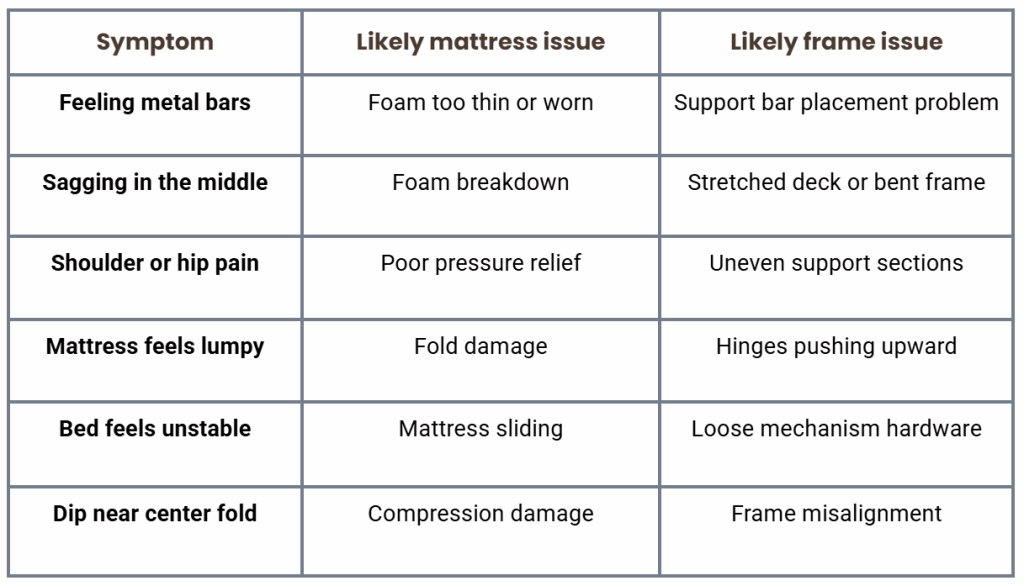
Mattress problem vs frame problem (quick comparison)
Need help choosing the right mattress?
We’ll help you find the right fit — no pressure, just expert advice.
Step-by-step diagnostic test
Step 1: Remove the mattress
Open the sofa bed and remove the mattress completely.
Lay it flat on the floor and check for visible sagging or unevenness. Press along different areas with your hand to determine where these spots may be.
What this tells you:
- If it still feels uneven, the mattress is the issue.
- If it feels fine, the frame is the issue.
Step 2: Test the frame without the mattress
Run your hand along the support surface of the mechanism (such as the deck, bars, or mesh). Look for:
- Bent or raised metal bars
- Loose joints
- Gaps or uneven support areas
What this tells you:
- If something feels wrong, the frame is the issue.
- If there is even support and a sound structure, the mattress is the issue.
Step 3: Test “sleep feel” on the frame
Carefully lie down on the frame (without the mattress) for a short test. Feel for sharp pressure points, or areas where your body may dip uncomfortably.
What this tells you:
- If you feel uncomfortable, especially in specific areas, it’s a frame issue.
- If everything feels even and you could doze off even without the mattress, it’s a mattress issue.
Common mattress vs frame failures
Mattress-related problems
These usually develop over time, even with a good frame. Foam breaks down or compresses, resulting in a loss of support and a gain of high-pressure zones. This means pain and discomfort for sleepers.
Frame-related problems
These often get mistaken for mattress failure, but bent support bars or sagging decking can create issues just as easily. A weakened frame results in uneven support and guaranteed discomfort.
The most common “false diagnosis” mistake
A very common mistake is assuming that the mattress is always to blame. In sleeper sofas, the frame and mattress are a team. If the frame is uneven, even a brand-new mattress will always feel “too thin” or create pressure points where none previously existed.
A failing frame means a bad sleep experience. Look there before buying a new mattress!
When the MATTRESS is for sure the problem
Replace the mattress if:
- It sags even when laid flat on the floor
- You can feel permanent body impressions
- Comfort improved temporarily after flipping or rotating (but didn’t last)
- The frame tests out as even and stable
When the mattress is the problem, your best bet will be an affordable, durable, and extra comfortable replacement made to match your mechanism perfectly. Another option can include a topper, though you will have to remove it before closing the sofa bed.
When the FRAME is for sure the problem
The frame is likely the issue if:
- You feel bars, joints, or hard pressure points
- Multiple mattresses have felt bad on the same sofa
- The sleeping surface looks uneven even without a mattress
- The sofa bed is older and has been heavily used
When the frame is the issue, you can sometimes fix the problem by tightening bolts or replacing failing decking. But if the bars are bent out of shape, you’ll likely have to replace the sofa bed.
When it’s BOTH
Sometimes both systems degrade together. This is common in:
- Older sleeper sofas (8+ years)
- Frequently used guest beds
- Lower-quality original builds
In this case, you may notice that a new mattress improves things slightly, but not fully due to feeling uneven or “lumpy” in certain zones.
Practical fixes (before replacing anything)
Before replacing major components, you can sometimes improve comfort.
- Add a thin comfort layer, such as a topper
- Tighten screws or replace the decking
- Check for misaligned folding sections
If these don’t help, the diagnosis is usually clear: one of the core components has reached its limit!
Questions and Answers
How do I know if my sleeper sofa mattress or frame is the problem?
A quick test is to remove the mattress and inspect both parts separately. If the mattress feels uneven on the floor, it’s likely the issue. If the frame has hard pressure points, bent bars, or uneven support, the frame is more likely the cause.
Why does my sleeper sofa still feel uncomfortable after replacing the mattress?
If a new mattress doesn’t improve comfort, the issue is usually the frame or support deck. Common causes include bent support bars, weak center support, or uneven folding mechanisms.
Can a bad frame damage a new sofa bed mattress?
Yes. A weak or uneven frame can cause a new mattress to wear out faster, develop sagging, or feel uncomfortable even if it started in good condition.
What does a failing sleeper sofa frame feel like?
A failing frame often feels like:
- Metal bars or joints through the mattress
- Uneven or “lumpy” sleeping areas
- Pressure points under hips or shoulders
- A dip or twist in the middle of the bed
How long should a sleeper sofa mattress last?
Most sleeper sofa mattresses last about 3 to 7 years, depending on usage and material quality. Frequent guest use or poor frame support can shorten that lifespan significantly.
Can I fix a sagging sleeper sofa without replacing anything?
Sometimes. Tightening loose frame parts, adjusting the mattress position, or adding a thin comfort layer can help temporarily. However, persistent sagging usually means either the mattress or frame has structurally failed.
Is it normal to feel the bars in a sofa bed?
No. Feeling bars or hinges through the mattress usually indicates either a thin or worn-out mattress, or a support frame issue that is not distributing weight evenly.
Should I replace the mattress or the frame first?
In most cases, it’s best to test the mattress first, since it’s the easier and more affordable fix. If a new mattress doesn’t solve the issue, the frame is likely the underlying cause.
Why does my sofa bed feel worse in the middle?
Mid-section sagging is typically caused by weak center support in the frame or compression in the middle of the mattress. This is one of the most common sleeper sofa problems and is often covered in related support diagnostics.
Step 2: Test the frame without the mattress