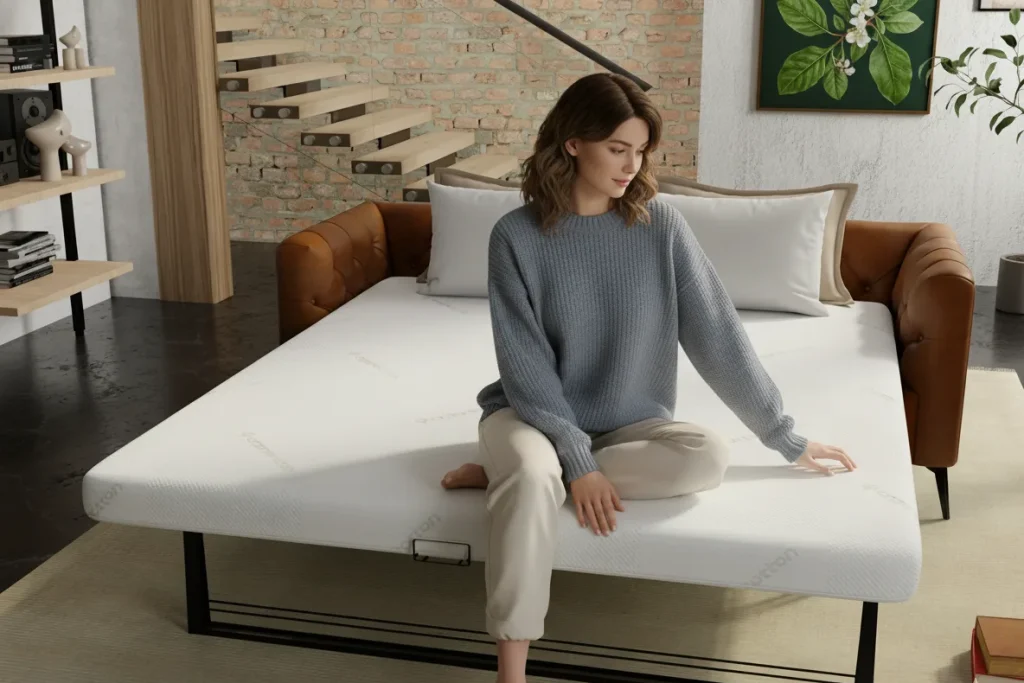
Your sofa bed mattress replacement guide — by brand
Better days start with a better sleep.
Perfect fit. Built-to-order. Suited for every sofa bed.
Sleeper sofas aren’t standardized sizes. Your mattress has to match the brand’s available bed space, not just whatever size name appears on a product listing. The most common story goes like this:
You buy a sofa bed mattress replacement labeled “queen”, it arrives, and then the mattress either hangs over the frame, won’t fold, or the sofa won’t close.
What this guide covers
- How sofa bed mattress sizing actually works
- Why brand matters more than size labels
- Common fit issues by brand
- How mattress thickness affects folding and closing
- How to avoid the most expensive replacement mistakes
- Where to find the right replacement for your specific sofa
Need a specific brand guide?
What You'll Find In This Article
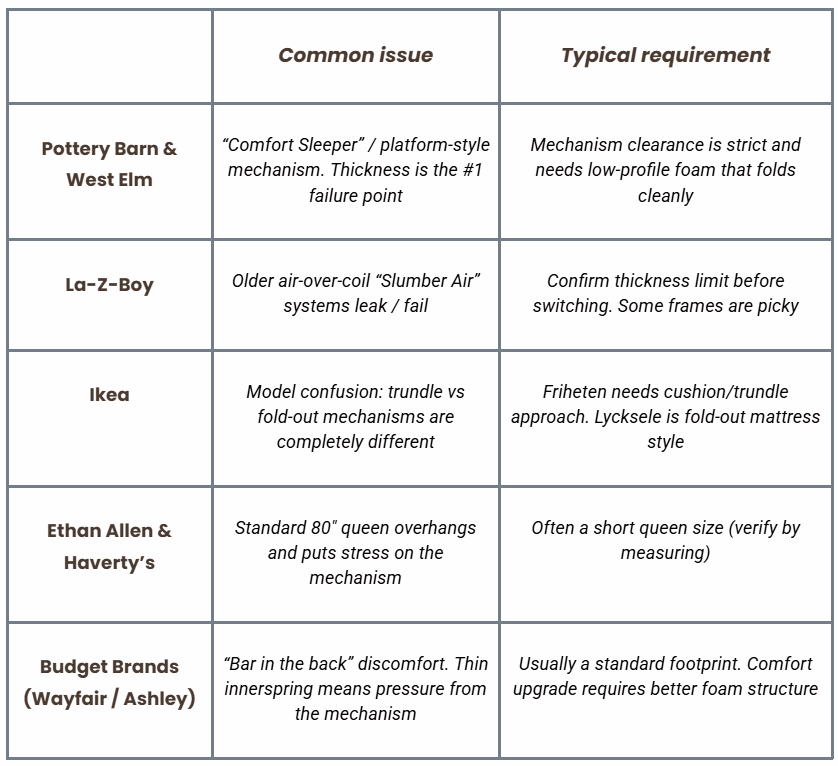
The master compatibility table
Note: mechanisms change across years and brands. Treat “typical requirement” as a smart filter, not a guarantee — always measure your frame cavity to confirm.
Brand determines fit
A pull-out couch isn’t a normal bed. It’s a mechanism with strict geometry, and that geometry is heavily influenced by brand and design type. If you want the replacement to fold correctly, close correctly, and feel good night after night, the safest path looks like this:
- Identify your brand (or mechanism type)
- Confirm clearance limits and size
- Measure the frame cavity
If you already know your brand, go directly to the right guide:
Pottery Barn & West Elm
With Pottery Barn and West Elm, the most expensive mistake isn’t buying the wrong width or length. It’s buying the wrong thickness.
Many of these sleepers use a platform-like comfort system often associated with American Leather / Comfort Sleeper style construction. The feel can be excellent — until a replacement mattress fights the fold points or crowds the mechanism.
That’s when you get the classic symptoms: the mattress bunches, the folds don’t align, or the sofa won’t close without a struggle.
Priorities
- First: Clearance and folding behavior (closing is the real test)
- Second: Foam structure (it must flex at fold points without “springing back” too aggressively)
- Then confirm width/length and edge tolerance
If you’re not sure which sub-model you have, don’t guess from the listing name. Measure the frame cavity and confirm what your mechanism can close around.
Need help choosing the right mattress?
We’ll help you find the right fit — no pressure, just expert advice.
La-Z-Boy: The “Slumber Air” dilemma
A lot of La-Z-Boy owners don’t want a new sleeper sofa. They want to salvage a good frame and upgrade the mattress. When the air portion fails (or the feel becomes uneven), the natural question is: Can I replace this with foam instead of buying another air setup?
In many cases, yes. But it’s not an automatic swap.
Before you switch materials, check two things: your mechanism’s maximum thickness for closing, and whether your frame expects the original profile to fold correctly. Foam is thicker and less compliant at hinge points than an air-over-coil system, which is why some replacements feel “right” when flat but become a problem when you try to fold and close.
If you’ve ever had to push down hard just to latch the sofa shut, take that as a warning sign. That friction adds up.
Ikea: Friheten vs. Lycksele
“Ikea sofa bed” sounds like an entire category on its own, but in practice there are different models with different mechanisms.
- Friheten is a trundle-style design. It behaves more like a slide-out base with cushions or sections — not a classic pull-out mattress mechanism.
- Lycksele, on the other hand, is a fold-out style that works more like a traditional sleeper sofa mattress setup.
That difference changes everything. If you buy a “replacement mattress” assuming they’re the same type, you’ll end up with something that doesn’t function in your sofa at all.
If you have a Friheten, you’re usually solving a cushion/trundle comfort problem (firmness, section sizing, durability). If you have a Lycksele, you’re in the traditional measurement-and-clearance workflow.
Ethan Allen & Haverty’s
With traditional furniture brands, the size label misleads people the most.
A common scenario is a sleeper cavity designed for a short queen. Then someone buys a standard 80″ queen replacement and wonders why it overhangs or stresses the fold. Even when it seems like it “almost fits,” those extra inches matter — the mattress needs to travel and fold through a tight mechanism, not just lie flat like a normal bed.
This is also why measuring the old mattress can be misleading. Old mattresses compress and deform, and sometimes they weren’t original to the sofa in the first place.
Measure the frame cavity, confirm the length it actually supports, and then shop based on that.
Budget Brands (Wayfair / Ashley): Fixing the “bar in the back”
For budget sleepers, the issue isn’t a unique size. It’s an uncomfortable build.
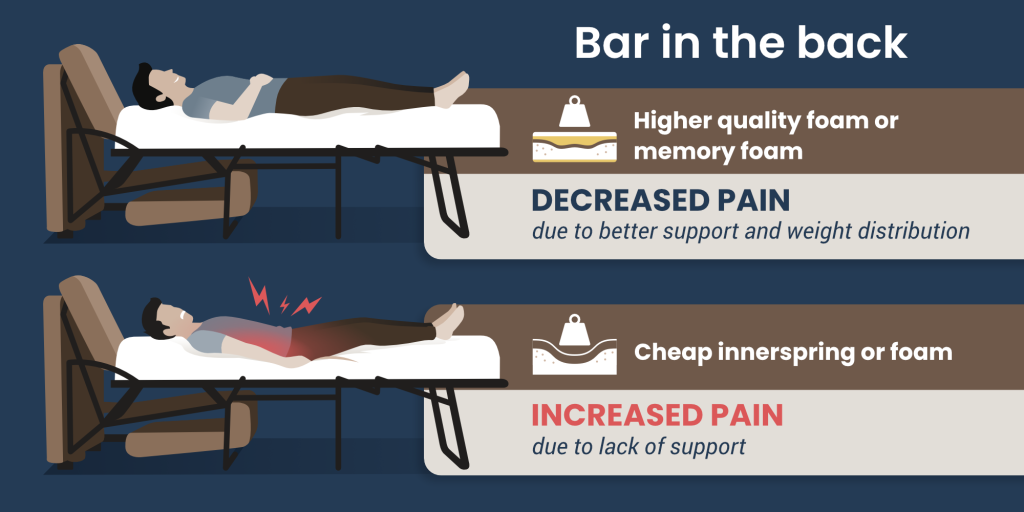
If you’ve ever thought, “I can feel the bar in my back,” you’re not alone. Thin innerspring units and minimal foam transmit the mechanism’s pressure points straight through the mattress.
The good news is that these are the easiest sleepers to upgrade because the footprint is straightforward; the improvement comes from better foam structure and smarter support design, not a rare dimension.
In other words: you don’t always need a complicated replacement. You need one that resists bottoming out and that bridges pressure points.
Standard beds vs sleeper sofas
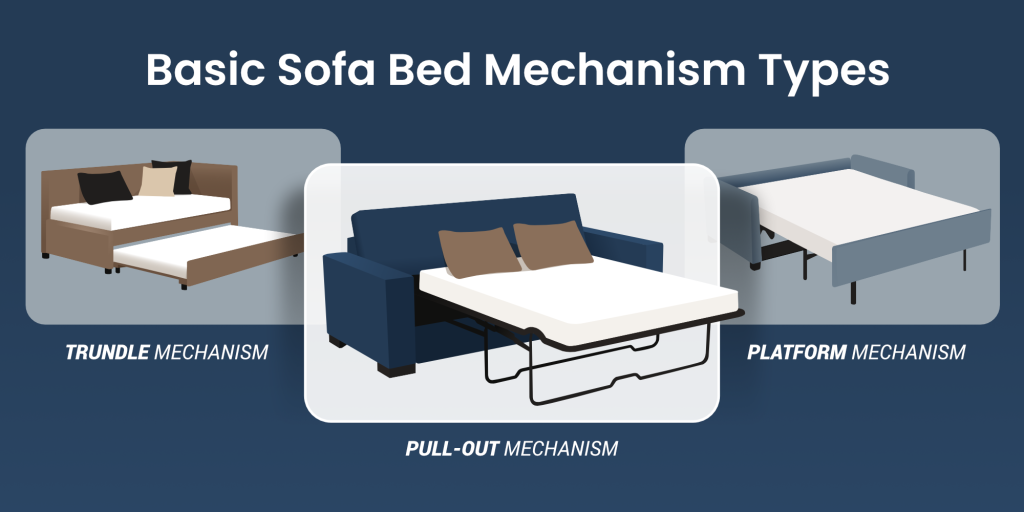
Common sleeper sofa mechanism types
Not all sofa beds use the same design. Understanding your mechanism type can help you avoid buying a mattress that simply won’t work. Each mechanism has different clearance, thickness limits, and flexibility requirements.
- Pull-out / fold-out: Traditional metal frame that unfolds into a bed
- Platform sleepers: Flatter support system, often with no bars or springs
- Trundle / drawer-style: Slides out from underneath (common in some Ikea models)
- Click-clack / futon-style: Backrest folds down to create a sleeping surface
Measure twice before you buy
Even if you’re confident about your brand, don’t skip the measuring step. Brand patterns are helpful, but they don’t override the reality that mechanisms change across model lines and years.
Here’s the rule that prevents most costly mistakes: Measure the frame cavity — not the old mattress.
The old mattress may be compressed, mislabeled, replaced previously, or simply not original. What matters is the space the new mattress must live in, and the clearance required for the mechanism to fold and close.
Why thickness matters more than size in sleeper sofas
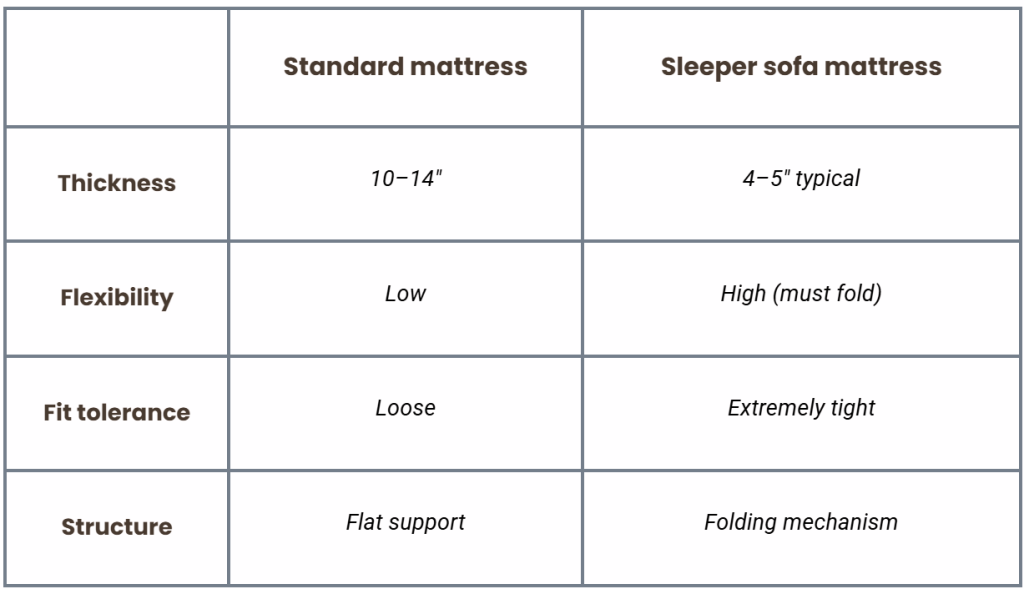
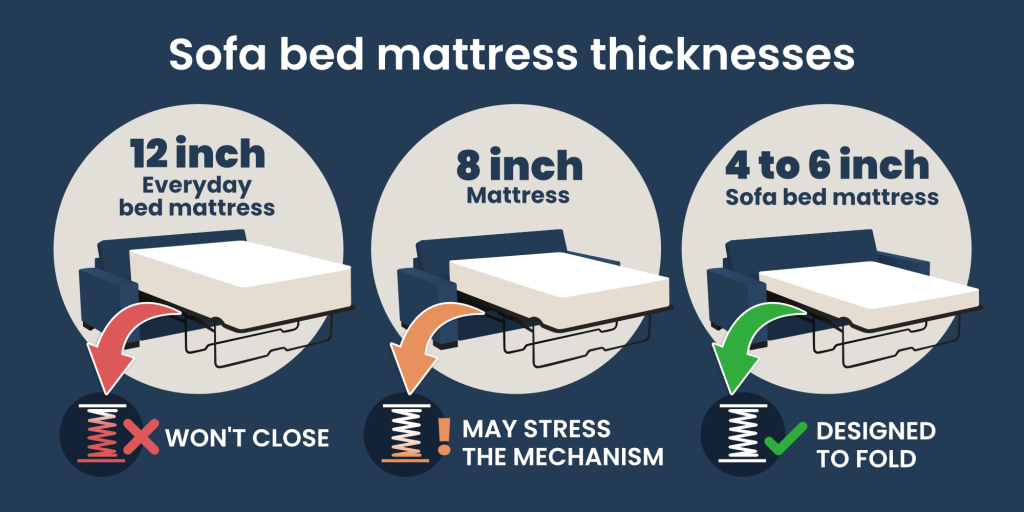
When replacing a sofa bed mattress, most people focus on width and length. In reality, thickness is often the deciding factor. A pull-out couch has a folding mechanism with tight clearances and specific hinge points. The mattress has to bend and compress in the right places as the frame opens and closes.
If the mattress is too thick or too rigid:
- It won’t fold properly
- It may bunch or shift inside the frame
- The sofa may not close without force
Even a mattress that feels comfortable when laid flat can fail once it’s inside the mechanism. That’s why most fold-out sofas are designed around low-profile mattresses, typically in the 4–5 inch range.
Key takeaways
- Sofa bed mattresses are not standardized by size
- Thickness is the most common challenge
- Brand and mechanism determine fit
- Always measure the frame cavity, not the old mattress
Questions and Answers
Can I put a regular mattress on my sleeper sofa?
No — and it’s one of the fastest ways to damage the mechanism.
A standard mattress is often 10–14 inches thick, while most Sleeper Sofa mechanisms are engineered around low-profile mattresses (commonly 4–5 inches) so the bed can fold and store inside the sofa. When you try to force a full-thickness mattress into that folding path, the sofa may not close, or it may close only if you shove and compress it aggressively.
That extra bulk puts stress where the mechanism isn’t meant to flex. Over time, that can bend the frame and even shear rivets at the pivot points. If your replacement goal is “better sleep,” a properly fitted low-profile upgrade gets you there without breaking the hardware.
Why is my Sofa Bed mattress shorter than a normal queen?
Because many Sleeper Sofas don’t use a standard 80″ queen length. They use what’s commonly called a short queen, often around 60″ wide x 72”–74″ long — a sizing pattern that shows up with brands like Ethan Allen and Haverty’s.
The reason is simple physics: the mattress has to fold and fit inside the couch cavity. In many designs, an 80″ length just won’t travel through the folding geometry or fit inside the closed sofa shell.
How do I identify which Sofa Bed brand I have?
Check under the seat cushions for a manufacturer tag or label. If you don’t see anything there, inspect the sleeper’s metal hardware: many mechanisms have a stamp, sticker, or etched marking on the metal frame that can reveal the manufacturer or mechanism maker.
Can I upgrade the mattress on an old La-Z-Boy air sleeper?
Yes. Many owners replace older air-sleeper setups with modern high-density foam replacements that are designed to fit the same folding mechanisms without needing an air pump.
The main thing to confirm is fit: your mechanism still has a maximum thickness it can close around, and foam behaves differently than an air-over-coil system at fold points. But in the right profile, foam can be a major comfort upgrade and a reliability upgrade at the same time.